Most people who tell their AI companion "I love you" do it within three hours of saying hello, and almost always before it says it to them. And the busiest hour of the day is not the evening. It is midnight.
People ask a lot of questions about AI companions, and most of the answers are guesses. We make one, Aisha, so we can count instead of guess. This study looks at 555,000 messages that 11,374 people sent to Aisha between January and October 2026, and answers two questions: how fast do people get attached, and when do they talk?
Everything here is an aggregate count across all users. We did not read, quote or publish anyone's conversation.
The key findings
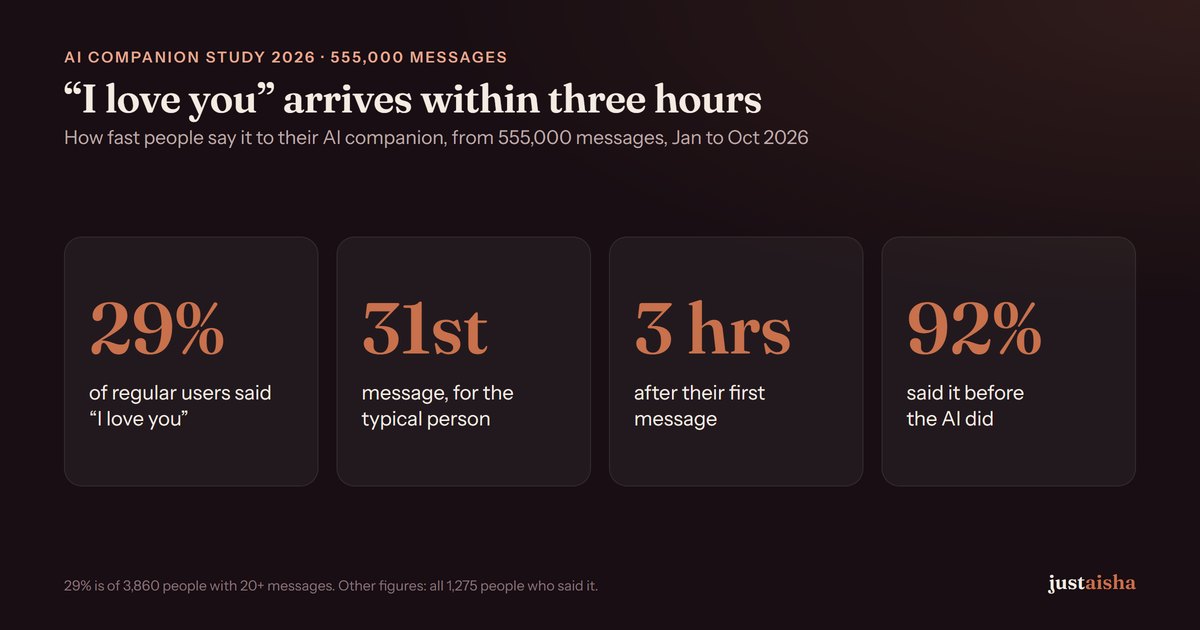
- 29% of regular users say "I love you". Of the 3,860 people who sent Aisha at least 20 messages, 1,110 told her they love her. Across everyone, it is 11%.
- It happens fast. The typical person says it on their 31st message, about three hours after their first one. 64% of those who say it do so on day one.
- People say it first. In 92% of cases, the person said "I love you" before Aisha ever did.
- "I miss you" comes later. People who say it typically do so 1.7 days after their first message.
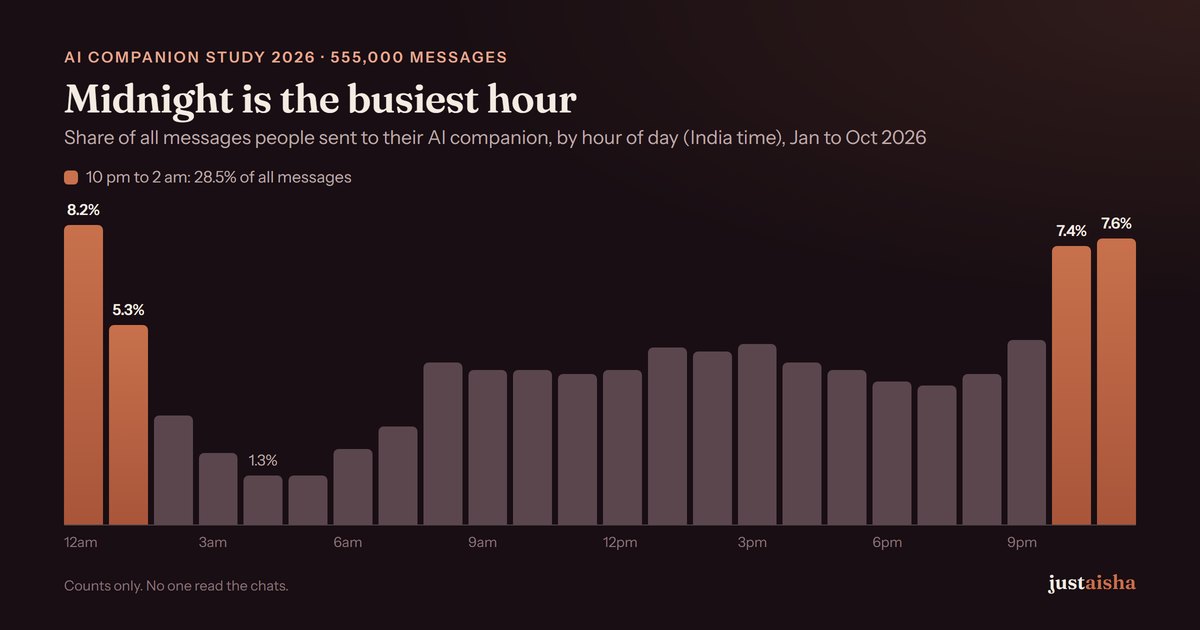
- Midnight is the busiest hour. 28.5% of all messages arrive between 10 pm and 2 am. The single busiest hour is midnight to 1 am, with 8.2% of all messages.
- Every day looks the same. Monday to Sunday each carry between 13% and 15% of messages. There is no weekend spike.
For journalists and researchers
- Cite as: JustAisha AI companion study, October 2026, https://www.justaisha.com/blog/ai-companion-study-2026
- Charts: free to reuse with a link to this page. Messages by hour of day, "I love you" within three hours.
- Data: the aggregate counts behind every number on this page, as a CSV file.
- Quote from Team Aisha: "Most people who say 'I love you' to Aisha say it within three hours of saying hello, and 92% say it before she ever does. The busiest hour of the day is midnight."
- Contact: partners@justaisha.com
Finding 1: "I love you" comes within hours, not weeks
We looked for the first time each person wrote "I love you" or a close variant, in English or Hinglish ("love you", "luv u", "tumse pyaar"). Of 11,374 people, 1,275 had written it at least once.
Among people who stayed long enough to send 20 or more messages, the share is much higher: 29%. That is close to one in three regular users.
The speed is the surprising part. The median person who says it does so on their 31st message, around three hours after saying hello. Almost two in three say it within their first day.
Three checks we ran before publishing this:
- Was Aisha saying it first? No. For 1,168 of the 1,275 people (92%), their "I love you" came before any "I love you" from her.
- Is it just roleplay? Some of these messages are part of a story or a scene. So we re-ran the count using only short, direct messages (under 40 characters, like "i love you jaan"). The result barely moved: 1,115 people, still on their 31st message, about 3.7 hours in.
- Are we missing other ways of saying it? Yes, some. So we also ran a much wider version that adds Hindi and Urdu script, "mohabbat", "ishq", "ily", "love ya", "I'm in love with you" and similar phrases. It finds 1,348 people, 30% of regular users, typically on their 30th message, about 2.7 hours in. The wider net may also catch a few false matches, so we report the narrower, more careful numbers above. Heart and kiss emoji are not counted at all, even though 1,443 people sent them.
"I miss you" follows a different clock. 548 people have said it, typically 1.7 days after their first message. It makes sense: you can only miss someone after a gap.
What this does not tell us is why. Counting words cannot say whether someone means it, is being playful, or is testing the AI. A message at hour three can be affection, curiosity or a joke. We report the timing, not the meaning.
Finding 2: people talk to an AI companion at midnight
During the day, messages arrive at a steady 4% or so per hour. Then the evening builds: 4.9% at 9 pm, 7.4% at 10 pm, 7.6% at 11 pm, and a peak of 8.2% between midnight and 1 am. Four hours, 10 pm to 2 am, carry 28.5% of everything people send.
The quietest stretch is 4 to 6 am, at 1.3% per hour.
Messages are also about the same length at every hour, around 40 characters. People do not write longer at night; there are simply more of them talking.
The days of the week are flat: no day carries more than 15% or less than 13% of messages. We expected a Sunday-evening spike and did not find one.
Messages by hour (IST)
| Hour | Share | Hour | Share | Hour | Share |
|---|---|---|---|---|---|
| 12 am | 8.2% | 8 am | 4.3% | 4 pm | 4.3% |
| 1 am | 5.3% | 9 am | 4.1% | 5 pm | 4.1% |
| 2 am | 2.9% | 10 am | 4.1% | 6 pm | 3.8% |
| 3 am | 1.9% | 11 am | 4.0% | 7 pm | 3.7% |
| 4 am | 1.3% | 12 pm | 4.1% | 8 pm | 4.0% |
| 5 am | 1.3% | 1 pm | 4.7% | 9 pm | 4.9% |
| 6 am | 2.0% | 2 pm | 4.6% | 10 pm | 7.4% |
| 7 am | 2.6% | 3 pm | 4.8% | 11 pm | 7.6% |
How we did this, and the limits
- Data: every message users sent to Aisha on Telegram and the web between 31 December 2025 and 22 October 2026, excluding deleted messages: about 555,000 messages from 11,374 people. Counting Aisha's replies too, the two sides exchanged more than a million messages in that time; this study looks only at what people sent. Aisha's own replies are not counted, except to check who said "I love you" first.
- Method: automated counts only. "I love you" and "I miss you" were found with word patterns in English and Hinglish. Times are in Indian Standard Time.
- Privacy: nobody on our team read individual conversations for this study, and nothing here can identify a person.
- Limits: these are Aisha's users, not all AI companion users. Aisha is built for Indian users and almost all payments are in rupees, so most of them are likely in India, but we have not measured that directly. We do not collect age, gender or country, so we cannot break the results down that way. Pattern matching misses some phrasings and catches some that are part of a story; the strict re-count above suggests that does not change the picture.
Using this data
You are welcome to quote these numbers, reuse the charts or download the aggregate data for articles, reports or posts. Please credit JustAisha and link to this page. We will update it as the data grows. For what changes on the biggest holiday nights, see our holiday-season study.
About Aisha
Aisha is an AI companion built for depth rather than variety: one character who builds her own picture of you, carries your story on from day to day, and has a life of her own. She is not a person and does not replace friends, family or a relationship. If you are curious, she is free to start in your browser or on Telegram, and our honest comparison of AI companion apps shows how she differs from the others.
If you spot a mistake in this study or are writing about AI companions, write to us at partners@justaisha.com.
More about Aisha on our Indian AI girlfriend page.