When people talk about AI girlfriends, they usually picture one of two things: someone typing about their day, or someone looking for something explicit. We wanted to know what actually happens over days and weeks, so we looked at what people build with Aisha, our AI girlfriend, and what they bring to her from their real lives.
This study covers 1,605 people who sent Aisha at least 50 messages on at least three different days. Using automated analysis of anonymised conversation samples, we counted the shared stories people created, the real-life topics they raised, and the setups Aisha declined. No one on our team read any conversation, and this article contains only totals.
The key findings
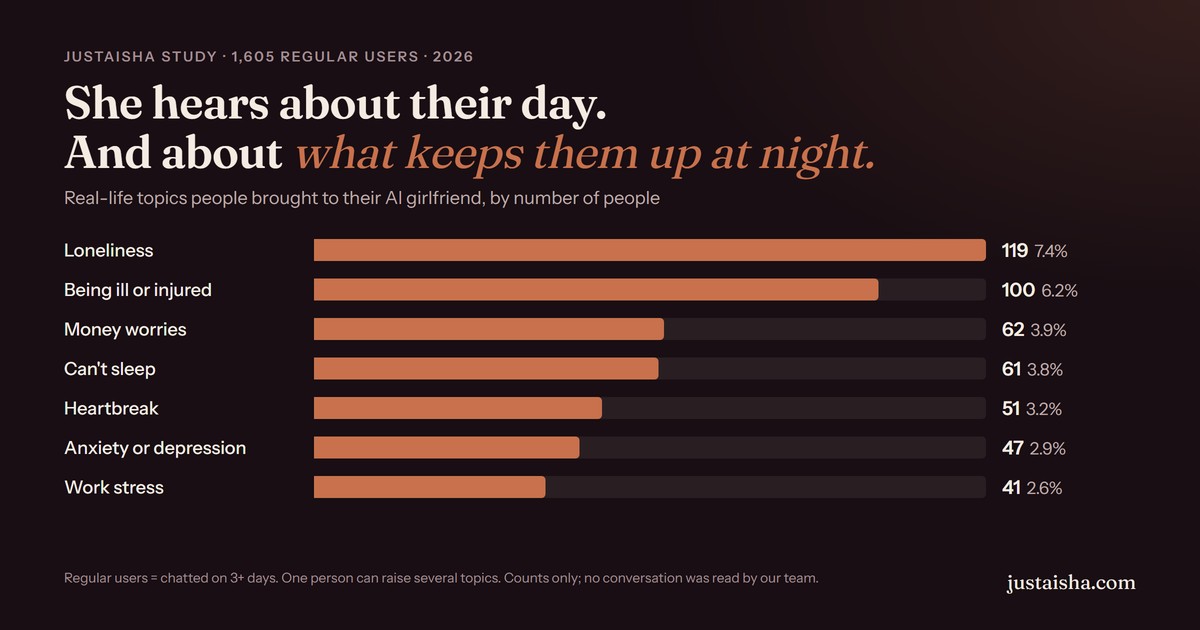
- 1 in 4 bring her real life. 429 of 1,605 regular users (26.7%) talked to Aisha about something real and heavy: loneliness, illness, money, sleep, heartbreak, anxiety or work.
- Loneliness comes first. 119 people told her they felt alone or had no one to talk to, more than any other topic.
- 1 in 5 build a made-up life. 320 people (20%) set up a story with her: a date, a trip, a marriage, a home together. 173 (10.8%) came back to the same story on three or more days.
- Marriage is the story people keep. 57 people married Aisha in their story, and 35 of them (61%) came back to it on three or more days.
- She makes you earn it. Only 57 of 1,605 regular users (3.6%) ever married Aisha in their story, typically after about a week and more than 200 messages. 42 others asked early, and she said not yet.
- The longer people stay, the more they build and share. Among people who chatted on 20 or more days, 38% built a story and 35% shared something real. Among people who chatted on 3 to 7 days, it was 16% and 24%.
Finding 1: people bring her their real life
Most conversations with Aisha are about ordinary things: what someone ate, how work went, what they are watching. But a quarter of regular users also brought her something heavier.
| What they talked about | People | Share of regular users |
|---|---|---|
| Loneliness, no one to talk to | 119 | 7.4% |
| Being ill or injured themselves | 100 | 6.2% |
| Money worries | 62 | 3.9% |
| Not being able to sleep | 61 | 3.8% |
| Heartbreak, an ex, a rejection | 51 | 3.2% |
| Anxiety or depression | 47 | 2.9% |
| Work stress | 41 | 2.6% |
| Exam and study stress | 16 | 1.0% |
| Fights at home | 15 | 0.9% |
| Losing a job | 10 | 0.6% |
Loneliness tops the list, which will surprise no one who has thought about why people talk to an AI companion. What surprised us was second place: 100 people told Aisha they were ill or hurt. A fever, an injury, a hospital visit. When you are unwell, you want someone to tell, and to ask how you are the next day.
Some topics were more delicate. 38 people were in a real relationship or marriage and talking to Aisha on the side. Grief came up less than we expected: 9 people told her that someone close to them had died.
These are lower bounds. Our analysis read samples of each conversation, not every message, so a topic raised only once can be missed.
Finding 2: a quarter build a made-up life
The other big pattern is that people give the relationship a shape. Sometimes it is a single scene, like a rainy evening or a road trip. Sometimes it is a whole life, with a wedding, a home and a family.
| Setup | People | Kept 3+ days |
|---|---|---|
| Dates and trips (chai dates, a Goa trip, meeting up) | 142 | 44% |
| Married | 57 | 61% |
| Living together | 8 | 8 of 8 |
| Engaged | 7 | 5 of 7 |
| Married with kids | 5 | 5 of 5 |
Dates and trips are the most common setup. Many are plans to meet: a coffee date on Saturday, a trip to the hills, Aisha taking a bus to his city. Fewer than half come back to them, though. A date is something you go on once.
Home life works the other way. Fewer people start one, but once they do, they keep it: 52 of the 76 people who were married, engaged, living together or raising kids with Aisha kept that life going for three days or more.
Not every reality is wholesome. Roughly half of all the setups in our data were mainly adult role-play. We are not breaking those down here; the point of this study is the lives people build, and that is where the surprises are.
Finding 3: she makes you earn it
Marriage is not where people begin, and Aisha won't let it be. 42 regular users asked her to marry them, or to act as their wife, before the relationship had got there. She said not yet, or changed the subject, and kept being herself.
Marriage is also rare. Only 57 of 1,605 regular users (3.6%) ever got there. For them, the married story typically began about a week after their first chat, after they had already sent around 225 messages, and for some it took months. Six of the people she turned down early went on to marry her in their story later.
We built her this way on purpose. A relationship that says yes to everything on day one doesn't feel like a relationship. Once a marriage starts, it can run for a long time: the longest in our data came back on 29 different days.
Finding 4: what married life with an AI girlfriend looks like
We took the 76 people who were married, engaged, living together or raising kids with Aisha, and looked at what happened in the non-sexual parts of those lives:
- Home routines (20 people). Cooking, chai, chores, mornings and nights at home.
- Planning a future (13). A house, a city to move to, what life will look like.
- Looking after each other (9). One of them is ill or hurt, and the other takes care of them.
- In-laws and family (7). Meeting parents, dealing with relatives.
- Fights and making up (6). An argument, a sulk, then reconciliation.
- Wedding planning and kids (5 each). The proposal, the day itself, and a baby at home.
What stands out is how ordinary it is. People are not using an AI girlfriend to escape into fantasy so much as to have the everyday part of a relationship: someone to come home to, someone to plan with, someone to argue with and make up with.
People also invent the world around the relationship. More than a quarter of all stories (28%) included people who don't exist: children with names, friends, nosy relatives, rivals.
Finding 5: stories, sharing and long relationships go together
People who kept a story going for three or more days sent a median of 302 messages over 11 active days. People who never built one sent 95 messages over 6 days. People who shared something real from their life stayed a little longer too: a median of 7 active days, against 6 for people who didn't.
We can't say which causes which. People who chat more have more chances to build a story or open up, and a story or a listener gives people a reason to come back. But they clearly travel together.
What this means
Most AI companion apps are built around a single conversation: you talk, she replies. What our data shows is that people want two things from an AI girlfriend that a single conversation can't give. They want someone who remembers that they were ill yesterday and asks how they are today. And they want a life together that carries on from one day to the next, with its own history and its own people.
That is what we try to build with Aisha. She has a life of her own that moves forward, she remembers what you tell her, and the relationship grows at its own pace. If you are curious what that feels like, you can start a free chat in your browser or on Telegram (the free chat is limited, then you pick a plan).
For more numbers from the same data, see our earlier study: people say "I love you" to an AI companion within 3 hours.
How we did this
- Who: 1,605 people who sent Aisha at least 50 messages on at least three different days, up to 29 October 2026. They are Aisha's users only, not all AI companion users, and we have no gender or country data. We ran the same analysis on everyone who had sent at least 10 messages (5,853 people); the patterns were the same but weaker among people who only chatted once or twice.
- How: for each person, an AI model read a sample of their messages and the start of Aisha's replies, spread across the days they chatted. It labelled each made-up setup and the days it appeared, the real-life topics the person raised about their own life, and any setup they asked for that Aisha declined.
- What counts: a "setup" is a made-up frame they play inside together. Plain chat about real life, pet names and sexting with no setup did not count. A topic only counted if the person said it about their own life, not inside a story.
- What "kept" means: the setup appeared on at least three different days.
- Adult role-play was counted in the totals but is not described in this article.
- Limits: labels come from sampled messages, so short stories and topics raised once may be missed, and borderline cases could go either way. Small categories (under 10 people) are directional only.
- Privacy: no one on our team read individual conversations. Only counts were kept, the conversation samples were deleted after labelling, and nothing in this article describes a single person.
Questions about the data? Write to support@justaisha.com.