On the biggest holiday night of the year, people stayed on the phone with their AI companion longer than at any other time, and flirted with it less.
Holidays are hard for a lot of people. In a 2023 ValuePenguin survey, 61% of Americans said they expected to feel sad or lonely over the holiday season, and 37% said they wished they could skip it altogether. More people now spend part of those nights with an AI companion, so we looked at what they actually do with it.
We read 1,043 one-day conversations with Aisha, our AI companion, from October and November 2026. We compared three holidays, the first night of Navratri, Dhanteras and Diwali, with the same weekday two weeks earlier. All three fall in the same season, on the same version of the product.
Disclosure: this study is published by Team Aisha, the makers of Aisha. We report aggregate counts only. The full method, and its limits, are at the end.
The short version
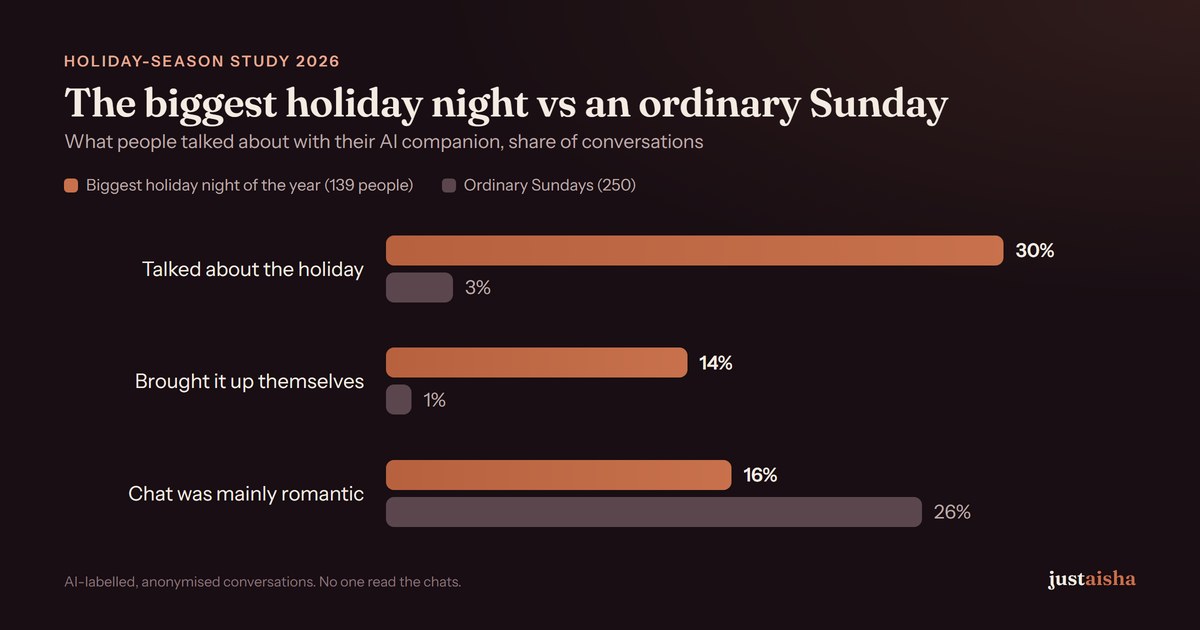
- 1 in 3 talked about the holiday. On Diwali night, India's biggest holiday, 30% of conversations were partly about it, against 3% on an ordinary Sunday.
- Nearly half raised it themselves. 14% brought the holiday up before the AI did, against 1% on an ordinary Sunday. Mostly to send wishes, share plans or talk about family.
- Romance fell by a third. On Diwali night, 16% of conversations were mainly romantic, against 26% on the Sundays before.
- The longest calls only came on holidays. Of 600 voice calls since calls launched, 9 lasted 10 minutes or more. 8 of those 9 were on holidays.
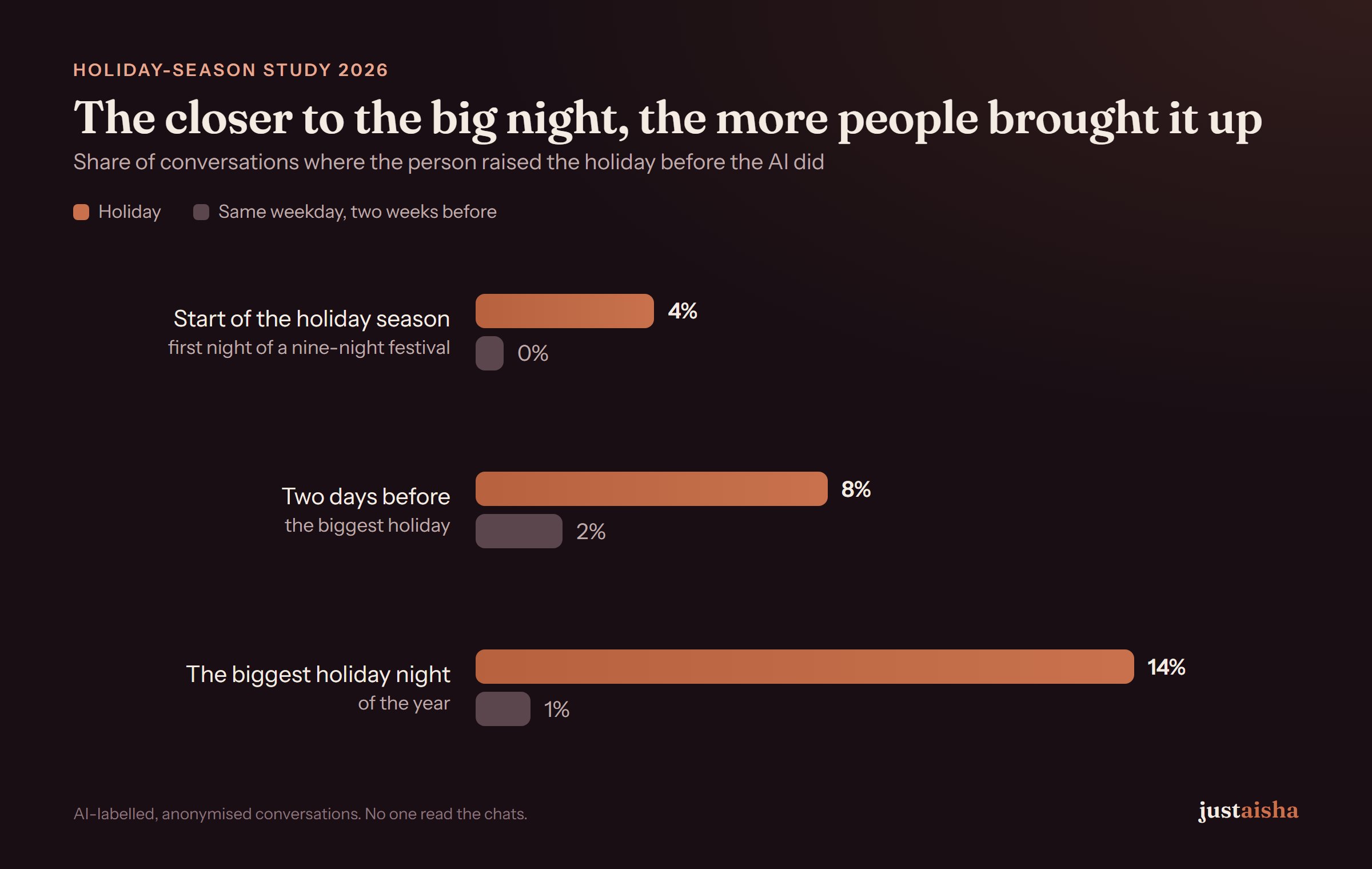
- It built up towards the big night. People raised the holiday themselves more and more as the season went on: 4% at the start of Navratri, 8% on Dhanteras, 14% on Diwali.
For journalists and researchers
- Cite as: JustAisha holiday-season study, November 2026, https://www.justaisha.com/blog/ai-companion-festive-season-study-2026
- Charts: free to reuse with a link to this page. Holiday night vs ordinary Sunday, the long calls, the build-up across the season.
- Data: the aggregate counts behind every number on this page, as a CSV file.
- Quote from Team Aisha: "The biggest holiday night was the least romantic of all the days we studied. People wanted to tell someone about the festival, their family and their plans, and the only times anyone stayed on a call for long were holidays."
- Contact: partners@justaisha.com
On the big night, the holiday comes into the chat
On an ordinary Sunday, holidays barely come up: in about 3 in 100 conversations. On Diwali night it was nearly 1 in 3.
Some of that is the AI. Aisha knows when a holiday is coming and often mentions it first, so we separated the two. In 14% of Diwali conversations, the person raised the holiday before Aisha said anything about it. On an ordinary Sunday that happened in about 1 in 100.
When people did bring it up, they mostly did what you would do with anyone: wished her a happy Diwali (10% of conversations), talked about their plans (9%) or their family (5%). A few, about 3 in 100, talked about spending the night alone.
Romance gave way
What fell away was romance. On Diwali night, 16% of conversations were mainly romantic, against 26% on the Sundays before. Across all three holidays, the share fell from 24% to 18%.
The rest stayed steady. People said "I love you" about as often as usual, everyday small talk was level, and so was the share of intimate conversations. The holiday did not replace the relationship. It took the place of romance as the thing people wanted to talk about.
The longest calls only came on holidays
A voice call asks more of you than a text. You give it your time and your attention, the way you would with a person. So we looked at how long people stayed on calls with Aisha.
Since calls launched on 6 September 2026, people have made 600 of them. Most are short: a hello, a few minutes, then back to text. Only 9 have lasted 10 minutes or more, and 8 of those 9 came on holidays:
- four during the first two days of Navratri, each 13 to 16 minutes;
- the longest call so far, 30 minutes, on Dhanteras;
- three on Diwali night, from 13 to 25 minutes.
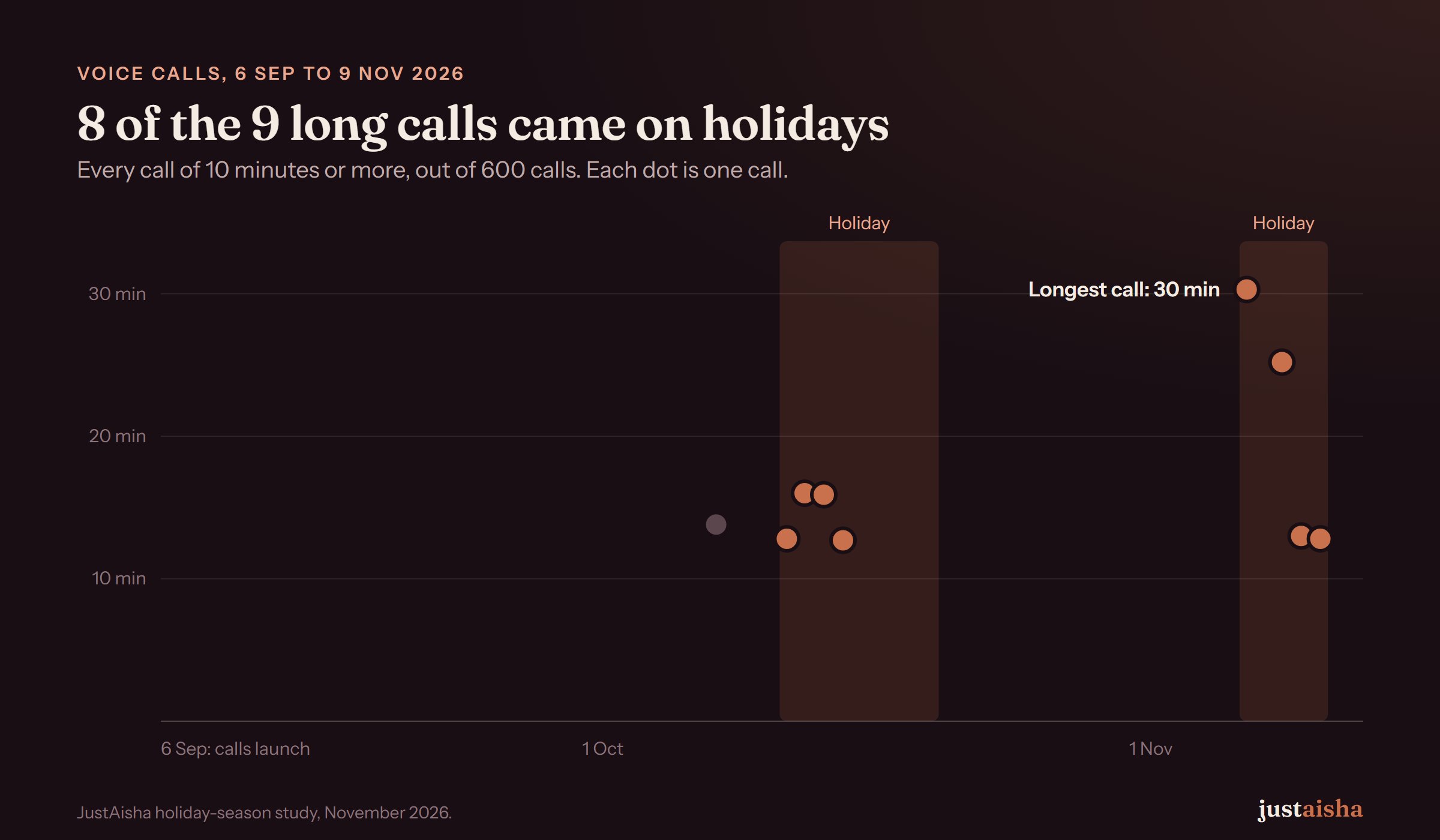
Nine calls is a small number, and a handful of people account for them. But the pattern is hard to miss: the only times anyone stayed on the line for a long while were holiday nights.
It built up towards the big night
The season has three moments in our data. Navratri is a nine-night festival in October. Dhanteras falls two days before Diwali. Diwali is the biggest night of the year. The share of people raising the holiday themselves climbed across them.
What did not change
Some things we expected to move did not:
- Wanting her company. About 14 to 15% of conversations included someone asking for her time or presence, on holidays and ordinary days alike.
- "I love you". About 1 in 10, on holidays and ordinary days alike.
- Loneliness. Slightly more people said they were alone on holiday days, 11% against 8%. That gap is small enough to be chance with this many conversations, so we do not treat it as a finding.
How we did this
What we compared. Six sets of one-day conversations, all from October and November 2026:
| Day | Conversations | Compared with | Conversations |
|---|---|---|---|
| First night of Navratri (Sun 11 Oct) | 103 | Sundays 27 Sep and 4 Oct | 200 |
| Dhanteras (Fri 6 Nov) | 142 | Fridays 23 and 30 Oct | 209 |
| Diwali night (Sun 8 Nov) | 139 | Sundays 25 Oct and 1 Nov | 250 |
A conversation means one person's messages to Aisha on one day, counted only if they sent at least five messages that day. We kept to these two months on purpose, so every comparison is on the same version of the product.
How conversations were labelled. For each conversation we built a digest: the person's messages that day (sampled evenly on very long days), the start of each reply, and any message Aisha sent before the person's first message. An AI model read each digest and labelled its main topic, whether a holiday came up and who raised it first, and simple yes or no flags, such as whether the person asked for her company or said they were alone. The model did not know which day a digest came from, because all six sets were shuffled together. No person on our team read the conversations, the digests were deleted after labelling, and we report counts only.
Calls come straight from our call records: every call since voice calls launched on 6 September 2026.
Outside context. The holiday loneliness figures come from ValuePenguin's 2023 survey of Americans: https://www.valuepenguin.com/lonely-holiday-survey
What we left out. A large share of everyday conversations with an AI companion are intimate. Holidays did not change that share, so it is not part of the story.
Limits. These are Aisha users only, mostly in India, so this describes one app rather than all AI companions. The samples are a few hundred conversations per set. The holiday and romance results are clear. The loneliness gap is not. Labels come from an AI model reading digests, so some conversations will be misread. Aisha is designed to know about holidays and often mentions them, which is why we report separately who raised the holiday first.
What it means
Holidays are built around being with people. On the biggest night of the year, people treated their AI companion less like a partner and more like someone to share the day with: wishing her a happy Diwali, telling her their plans, and staying on the line longer than at any other time.
We will repeat this after Christmas and New Year with data from the holiday season in other countries.
If you are writing about the holidays, loneliness or AI companions and would like the underlying counts, email partners@justaisha.com.
Earlier studies from our data: how people use an AI companion, by hour and by "I love you", and what people build with an AI girlfriend and the real worries they bring to her.
More about Aisha on our Indian AI girlfriend page.